Basics


Info Download

Advanced

v/v
V
V

Plot Download

Mesubuta 13031363201 Wakana Teshima Jav Uncen Jun 2026

Japanese culture is deeply intertwined with its entertainment industry, reflecting the country's values, traditions, and aesthetics. The concept of "wa" (harmony) is central to Japanese culture, emphasizing the importance of balance, respect, and community. This is reflected in the entertainment industry, where collaboration and teamwork are often prioritized over individualism.

In the early 2000s, the Japanese government recognized the economic value of its cultural exports and launched the "Cool Japan" initiative. This state-sponsored strategy aimed to turn the country's soft power—its anime, food, games, and fashion—into economic growth and tourism.

Understanding this powerhouse requires looking past individual anime or video games. It demands an examination of how historical roots, unique business frameworks, and passionate fan cultures interact to create a global phenomenon. The Dual DNA: Tradition Meets Tomorrow mesubuta 13031363201 wakana teshima jav uncen

Once marginalized as "trash culture," anime and manga have evolved into Japan’s most effective tools for cultural diplomacy. By 2024, the global market for these mediums reached .

: Modern acts like Yoasobi, Kenshi Yonezu, and Babymetal are breaking traditional domestic boundaries to find massive international success online. Television and Cinema: From Kurosawa to Reality TV In the early 2000s, the Japanese government recognized

Recognizing the immense economic value of its cultural exports, the Japanese government institutionalized these creative industries under the "Cool Japan" initiative. This national strategy promotes everything from fashion and food (washoku) to anime and tech, leveraging culture to boost tourism, foreign investment, and diplomatic influence.

Companies like Nintendo and Sony Interactive Entertainment have consistently dictated the direction of global gaming console generations. It demands an examination of how historical roots,

: Partnerships with global streaming services are exposing international audiences to Japanese reality shows and gritty live-action thrillers. The Intersect of Culture and Entertainment

The cultural resonance of anime lies in its visual language that borrows from ukiyo-e (flat perspectives, bold lines) and its narrative focus. Unlike Western cartoons’ episodic reset, anime often features serialized, novel-like arcs centered on the "power of friendship" ( nakama ) and the tragedy of the ronin (masterless wanderer).

The Japanese entertainment industry and culture represent a powerful fusion of deep-rooted traditions and cutting-edge global trends. From the historic stages of Kabuki to the global phenomenon of anime, Japan has mastered the art of cultural export. This unique mix has turned the country into a cultural superpower, captivating audiences worldwide and shaping international media consumption. The Foundation of Traditional Arts

The term otaku refers to people with obsessive interests, commonly associated with anime, manga, and gaming. Tokyo’s Akihabara district serves as the global mecca for this subculture. What was once viewed domesticly as a negative social withdrawal has transformed into a major driver of tourism and economic revenue, celebrated for its consumer passion. Soft Power and Global Future
Disclaimer: This tool is provided for educational and illustrative purposes only. No guarantee is made regarding accuracy, suitability, or performance. Use at your own risk. - Copyright: ufelectronics.eu / Andreas Dyhrberg

×
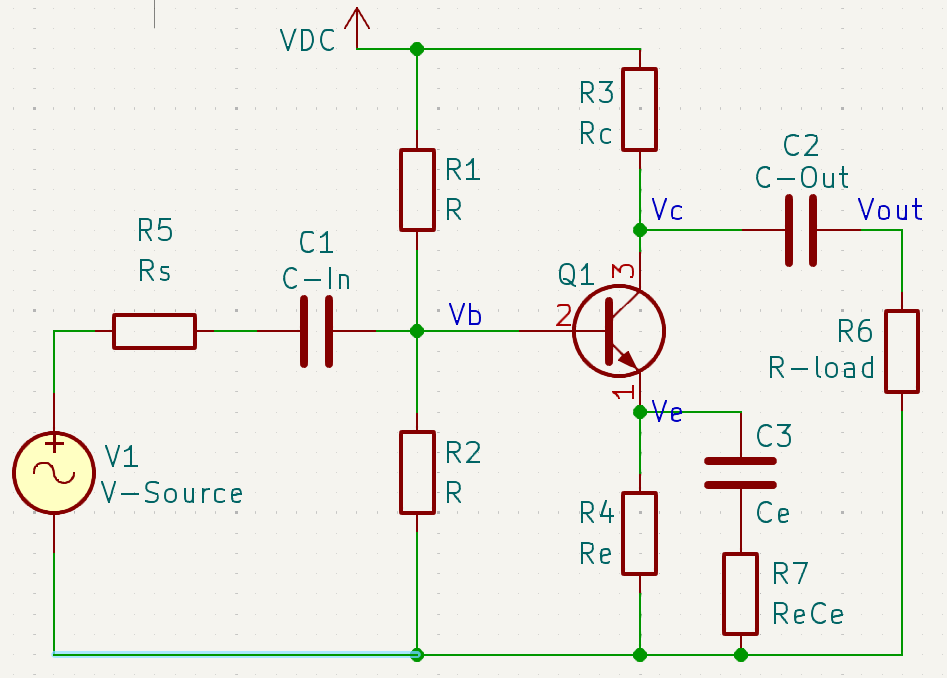
Amplifier Schematic
×

There are different ways to calculate an amplifier, depending on what you want to achieve.

Maybe you want to achieve a certain gain, as far as possible (classic mode). Or you have a low Vcc to respect (modern mode). Or you work with analog audio amps (symmetry mode).

Depending on what you want to achieve and the way of calculating it. Some fields might become dependent on others, or the other way around.

Your above choise makes some input fields available for manipulation, while hiding others.


🎯 1. Target Gain (Av) — "Classic mode"

You care about how much your amplifier multiplies the input signal.

Set desired voltage gain and Rc voltage drop. Best for learning and simple amplifiers.

You say: “I want a gain of 10.”
The app adjusts resistors to try and match that.
You must give Av and Vrc (the voltage dropped across Rc).

Best for common emitter amplifiers.

✅ Default choice for most beginners and educational use.


⚡ 2. Target Emitter Voltage (Ve) — "Modern mode"

You care about setting a healthy DC bias point.

Prioritize stable biasing via Ve. Useful for low-voltage circuits or precision designs.

You say: “I want Ve = 0.5 V, to keep the transistor out of trouble.”
This makes sure your transistor stays in active mode.
Gain becomes whatever it turns out to be.

Ideal for common emitter amplifiers when the goal is to ensure proper biasing for low-voltage or precision circuits, and it’s also used in class AB amplifiers to prevent distortion

✅ Useful in low-voltage designs (e.g., 3.3V systems).


🧭 3. Target Collector Voltage (Vc) — "Symmetry mode"

You want to place the collector in the middle of the power rail.

Target Vc = Vcc/2 for maximum signal swing. Great for audio and analog signals.

You say: “Make Vc = Vcc/2” for maximum swing.
Useful for analog audio amps or symmetrical headroom.
Gain and Ve are outcomes.

Best for common collector amplifiers and class AB amplifiers.

✅ Best for signal integrity.

×

Features and Requirements

✅ Functional Features

  • Support for Four Amplifier Types
    • Common Emitter (CE)
    • Common Collector (CC)
    • Common Base (CB)
    • Class AB (AB)
  • Constraint Modes
    • Target Gain (Av) – “Classic mode”
    • Target Emitter Voltage (Ve) – “Modern mode”
    • Target Collector Voltage (Vc) – “Symmetry mode”
  • Input Parameters
    • Vcc, Ic, β (gain), Rs, Rl
    • Ve, Vc, Av, Vrc (depending on mode)
    • Divider current ratio
    • Transistor model selection
    • Resistor series (E12, E24, E96)
    • Target low cutoff frequency
    • Bypass capacitor selection (Yes/No)
  • Calculation Features
    • Resistor values (Rc, Re, R1, R2)
    • Input and output impedance (Zin, Zout)
    • Voltage gain, overall gain
    • Maximum input/output swing
    • Capacitor sizing: Cin, Cout, Cbypass
    • Support for standard resistor rounding and color band visualization
    • Model-aware parasitic capacitance (Cbe, Cbc) and effect on fc

✅ Educational Features

  • Visual Feedback
    • Schematic changes with amplifier type
    • Constraint mode helper and long explanation section
    • Graphs: gain vs frequency, swing diagram
  • User Interface Enhancements
    • Responsive layout
    • Constraint help tooltip
    • Collapsible “Longer Explanation” for constraint modes
    • Zoom controls
    • Dynamic timestamping for exports
  • Export and Print Features
    • CSV/XML export
    • Clipboard copy of results
    • Resistor and capacitor export
    • Print-friendly layout